
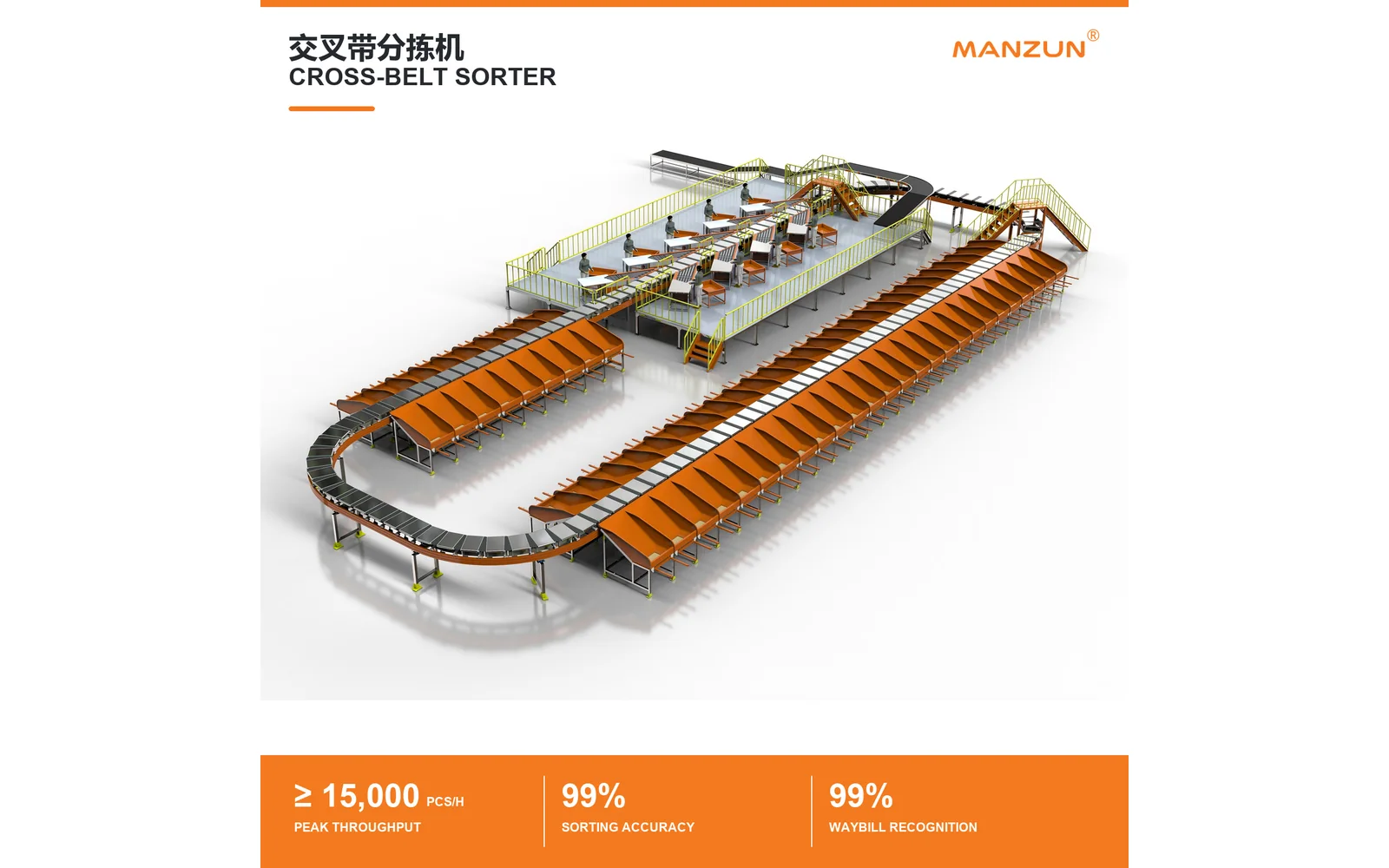
A circular cross belt sorter carries parcels around a closed loop and discharges each item at its assigned destination. For a buyer, the right system is defined by the parcel mix, peak operating window, induction capacity and chute collection plan together. This guide explains what to verify with a cross belt sorter manufacturer before comparing quotations.
When does a circular cross belt sorter make sense?
A loop sorter can serve multiple destinations around its route and return undischarged parcels for another pass when the system is designed for recirculation. It can fit express hubs and e-commerce distribution centres with many routes. A straight building or a small number of destinations may favour a linear sorter or another conveyor arrangement, so ask for a layout comparison before choosing the loop.
How should parcel samples determine the carrier?
List the minimum and maximum length, width, height and weight, then add package types and their share of the flow. Include soft mailers, flat envelopes, uneven cartons and fragile items if they occur in daily operation. Ask the supplier to test actual samples at induction, on curves and at discharge, including their landing in the receiving chute.
Carrier dimensions and pitch influence how a parcel is supported and how much spacing it needs. Long parcels may require coordinated support from two carriers in a suitable configuration. Confirm the permitted overhang and weight with the supplier, and agree on a separate route for items that fall outside the tested range.
How much cross belt sorter capacity do you really need?
Start with the peak shift rather than a daily average. For example, 40,000 parcels that must be processed in eight hours require an average of 5,000 parcels per hour during that window. Peaks within the shift, breaks, exceptions and equipment availability require separate allowance, so 5,000 is a starting calculation rather than a machine specification.
Carrier speed alone does not establish finished throughput. Ask how many induction points are needed, how parcels are separated and scanned, how often carriers are occupied and how quickly full chutes are cleared. Recirculated parcels also occupy carrier capacity. Request a capacity calculation for the agreed mix and operating assumptions.
How should induction, scanning and chutes be planned?
Compare manual and automatic induction against the incoming flow and available staffing. Confirm where labels are read, how parcel IDs reach the controls and what happens when a barcode cannot be read. A parcel must be associated with the correct carrier before the system can send it to a destination.
Map each destination to a chute, bag, container or takeaway conveyor. Check chute pitch, working access, bag changes, downstream capacity and any routes needing more than one outlet. Observe actual discharge with both light bags and rigid cartons. A sorter can keep moving while a blocked chute slows the whole operation.
What should a cross belt sorter quotation include?
Request the proposed loop drawing, carrier quantity and pitch, induction equipment, scanning, chutes, controls and software interfaces. Ask for the boundary of supply, installation, commissioning, training, spare parts and after-sales support. Confirm whether conveyors, electrical work and building modifications are included so that quotations can be compared on the same scope.
Agree on a factory or site acceptance test before ordering. The test should define the sample mix, peak operating conditions, identification and routing method, exception scenarios, measurement period and the responsibilities for clearing destinations. A headline accuracy or parcels-per-hour figure is useful only with its test conditions.
How do you compare cross belt sorter manufacturers?
Ask each supplier to explain the carrier drive, maintenance access, belt and roller replacement, available spare parts and the control interface to your warehouse or sorting software. Review relevant installations with similar parcels and routes, and establish who will support the site after commissioning.
MANZUN lists a typical cross-belt throughput of 7,000–9,000 parcels per hour and a typical parcel weight of 0.1–20 kg in its product reference. These are planning references for a defined configuration. Actual capacity and the accepted parcel range must be confirmed against samples, layout and the final system design.
Before requesting a proposal, prepare a floor plan, peak-hour forecast, destination list, parcel samples and dispatch schedule. Ask the supplier to mark induction, chute access, exception handling and maintenance space on the drawing. The resulting layout gives both teams a concrete basis for the quotation.
Published on 2026-10-29. Product information reflects the publication date; contact us for current specifications and availability.