
Induction is the part of a sorting line that decides how many parcels actually enter the system every hour. Carrier speed and the number of chutes set the ceiling; the induction plan decides how much of that ceiling the operation reaches.
Why does induction limit the throughput of a sorting line?
A sorter can only discharge parcels that have been placed on a carrier, identified and linked to a destination. Each parcel needs a gap ahead and behind so that two items are not discharged together. If a station cannot keep that spacing at the required rate, the line runs below what its carriers could carry.
That is why two projects with the same sorter model report different hourly figures. The equipment can be identical while the induction area, the scanning arrangement and the staffing are not.
How do you estimate the capacity of one induction station?
Start with spacing and speed. If parcels enter a lane about 700 mm apart and the belt runs at 1.8 m/s, one lane can pass roughly 9,000 parcels per hour in theory. That is a geometric limit rather than a working rate: no-reads, awkward parcels, operator pace, gaps inserted for tracking and short stoppages all reduce it.
Working rates for manual or assisted induction therefore sit well below the geometric figure, and the difference grows with soft, irregular or fragile parcels that need hand orientation. Ask the supplier for the rate their station reached with your parcel samples, not one headline number for the whole line.
How many stations does an hourly target require?
Divide the peak-hour target by the rate one station sustains in the tested mix, then add allowance for shift changes, gaps in the incoming flow, exception handling and maintenance. A peak of 10,000 parcels per hour with stations sustaining about 2,500 per hour needs four stations working together, plus the staff to keep them fed.
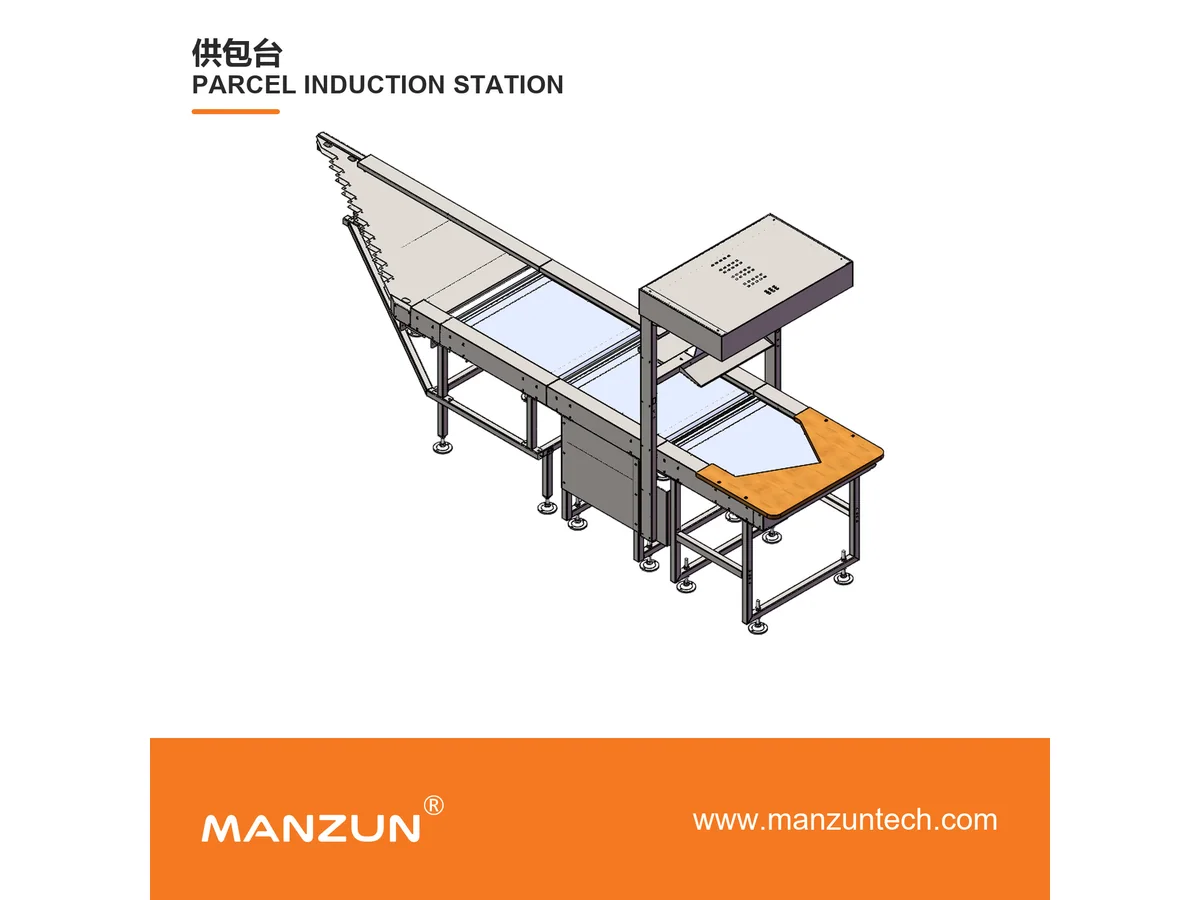
One reference is the Luoyang project, where the circular cross-belt installation has four three-section induction platforms feeding 167 carts and 169 chutes, with a recorded throughput of 8,000 parcels per hour. That figure belongs to that installation; a different parcel mix or layout will produce a different result.
Should induction be manual, assisted or automatic?
Manual induction suits modest volumes, mixed parcels and operations that already have people at the line. Assisted induction adds conveyors, weighing or dimensioning so the operator only has to position the parcel. Automatic induction uses singulation and scanning equipment to feed the sorter without a person at every station.
The trade-off is not only labour cost. Automatic induction needs floor space, a stable parcel envelope and maintenance capability on site. Manual induction depends on consistent operator performance across shifts and a plan for absences. The peak window, not the annual average, decides which one fits.
What has to happen at the scan point?
A parcel has to be associated with the carrier it occupies before the sorter can route it. A label is read at a known position, the reading is passed to the control system, and the system records which carrier received the parcel. If any of those steps is unreliable, the parcel is routed by exception instead of by destination.
Check where labels actually sit on the parcels you handle: curved surfaces, transparent film, print quality and hand-applied labels. Ask how the system behaves when a label is read twice, or when two parcels arrive with the same identity.
How should unreadable and rejected parcels be handled?
Most projects need an exception path: a place where parcels without a valid destination are removed, re-labelled or sent to a default chute. Plan that path before commissioning, because adding it later usually competes for the same floor space as the induction area.
Recirculation is the other half of the question. A parcel that is not discharged on the first pass may travel round the loop again, which uses carrier capacity and can disturb the spacing at induction. Decide how many passes are acceptable and what happens after the last one.
What should a quotation state about induction?
Ask for the number of stations, the equipment at each one, the staffing assumption and the tested rate behind any capacity figure. Confirm whether conveyors, scanners, weighing, dimensioning, the exception station and the operator interface sit inside the supply boundary. Without that, two quotations can look comparable and still deliver different lines.
A workable induction plan answers four questions together: how many parcels per hour, how the parcels arrive, who places them on the line and what happens to the ones that cannot be read. Settle those before choosing the sorter model, and the throughput discussion becomes a calculation instead of a claim.
Frequently asked questions
How many parcels per hour can one induction station handle?
It depends on spacing, speed and parcel mix. A lane with parcels about 700 mm apart at 1.8 m/s has a geometric limit near 9,000 parcels per hour, but tested working rates are much lower. Ask for the rate measured with your own samples.
How many induction stations do I need for 10,000 parcels per hour?
Divide the target by the tested rate per station and add allowance for shift changes, gaps in the incoming flow and exceptions. At about 2,500 parcels per hour per station in the tested mix, four stations plus feeding staff is a starting point.
Is automatic induction always better than manual induction?
No. Automatic induction needs floor space, a stable parcel envelope and on-site maintenance capability. Modest or very mixed flows often run better with assisted manual induction and a defined exception path.
What happens to parcels whose labels cannot be read?
They follow a planned exception path: removed from the line, re-labelled, or sent to a default chute. Recirculation should be limited to an agreed number of passes, with a defined outcome after the last one.
Published on 2026-11-05. Product information reflects the publication date; contact us for current specifications and availability.