
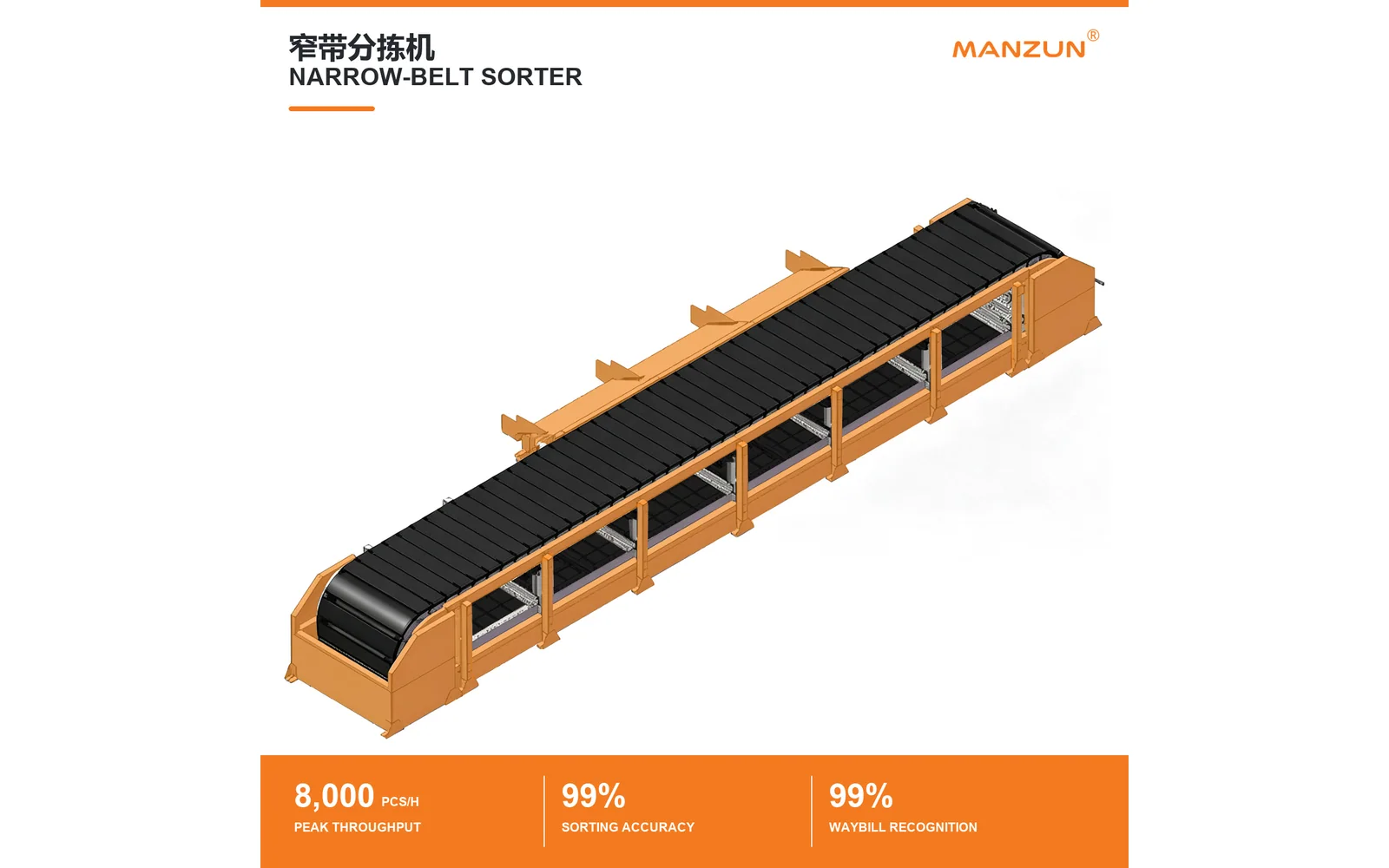
A narrow belt sorter moves each parcel on a belt-equipped carrier along a straight sorting line. The control system associates the parcel with a destination, tracks its carrier and starts the short belt at the assigned chute. The parcel then moves sideways off the line. This article follows the carrier-based narrow belt sorter shown in MANZUN’s product range; other machines sold under the same name can use different divert mechanisms.
What happens before a parcel reaches the sorter?
The induction conveyor presents parcels with enough separation for the chosen carrier arrangement. An operator or upstream system supplies the route decision, while a scanner or other identification point reads the parcel before its first possible destination. If the code cannot be read, the controls need a defined exception route rather than guessing where the parcel belongs.
During induction, the parcel must sit securely on its carrier or assigned group of carriers. A long carton may need more support than a small, rigid box. A flexible mailer may fold or shift as it enters. These are reasons to test actual packaging at the intended feed rate, even when its dimensions fall within a catalogue range.
How does the sorter know when to discharge?
The control system links the parcel record, carrier position and destination. Position feedback lets it issue the discharge command when the carrier reaches the selected chute. The belt on that carrier runs across the direction of travel and transfers the parcel sideways. The main line and the short belt therefore perform different jobs, and their timing must agree.
The chute entrance receives the parcel immediately after it leaves the carrier. Its height, width and surface influence whether a soft bag catches at an edge or a carton continues into the collection area. A discharge test should follow the item all the way into its container or takeaway conveyor, not stop when it leaves the sorter.
What happens to unread parcels or a full destination?
An unread label, a parcel outside the accepted range or a destination that cannot receive another item needs a configured response. Depending on the site layout, that may be a dedicated exception chute, a recirculation path or a stopped feed for manual handling. The decision belongs in the control and collection plan before the line goes live.
A full chute can also reduce effective throughput while the mechanical sorter continues to run. Peak-hour volume must therefore be checked against induction spacing, route distribution and the time needed to clear each collection point. MANZUN’s published throughput range describes a typical configuration; it is not a promise for an unspecified parcel mix or building.
Which parts should a buyer inspect in a working demonstration?
Watch one representative carton, one soft bag and one thin item from induction through identification, tracking, belt discharge and collection. Check the parcel’s position on the carrier, its landing at the chute entrance and the response to an unread label. Ask how the operator clears a full chute and reaches the belt, roller and sensors for maintenance.
For a project discussion, bring parcel samples, the peak-hour flow, a route table and a floor plan. Those inputs let the carrier width, induction method, chute layout and exception path be tested as one operating system.
Published on 2026-09-27. Product information reflects the publication date; contact us for current specifications and availability.