
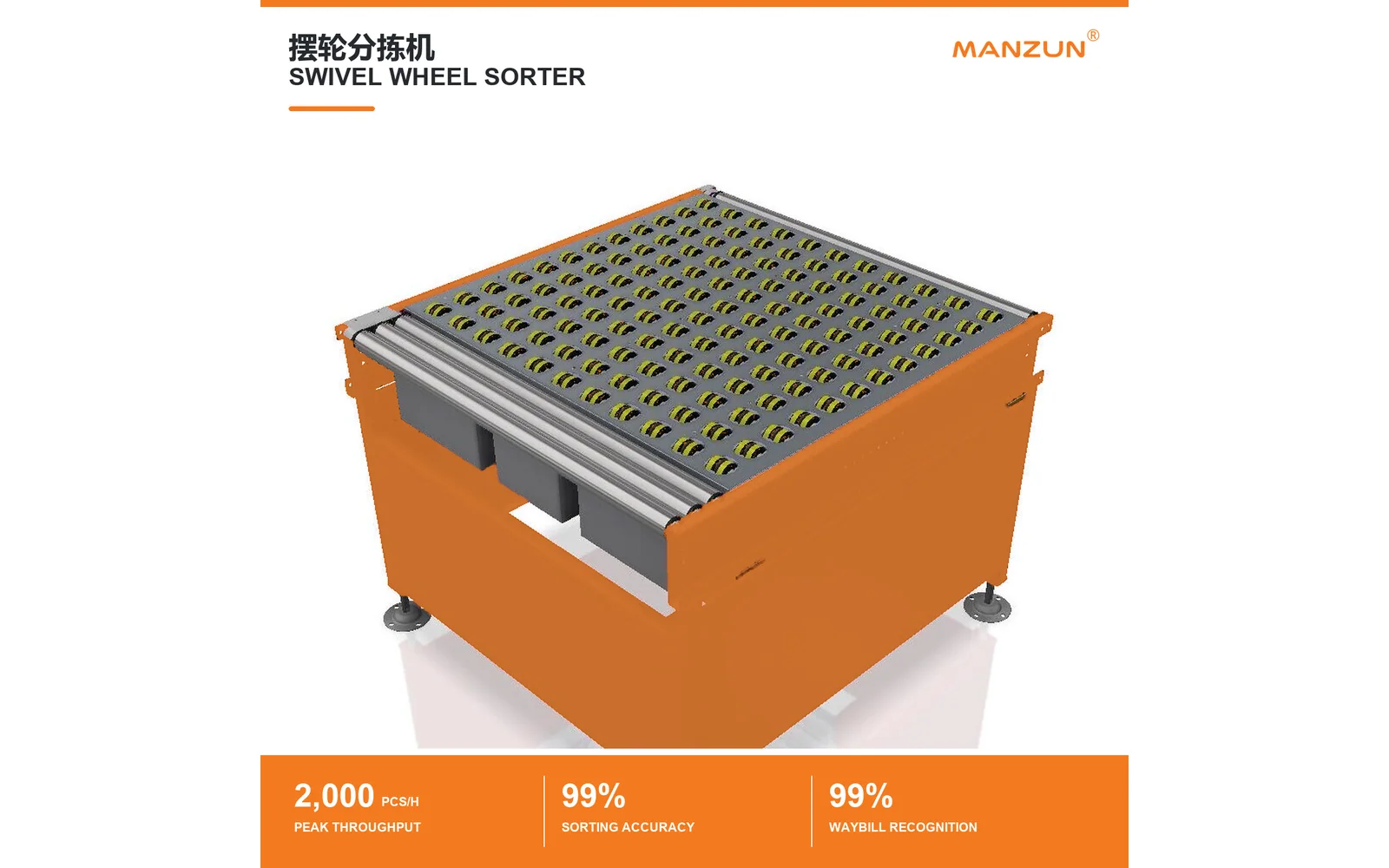
A swivel-wheel sorter diverts a parcel at a conveyor junction. Powered wheels change their angle so the item continues toward the selected branch. It is useful when cartons and suitable parcels need to leave a main conveyor at a compact transfer point. The upstream flow, parcel bottom and receiving branch determine whether the module is suitable.
How does a swivel-wheel diverter differ from a carrier sorter?
A cross-belt or narrow-belt sorter assigns parcels to carriers along a dedicated sorting line. A swivel-wheel module sits in a conveyor path and changes the travel direction at a junction. It can therefore suit a small number of branch decisions or act as one part of a larger line; the two arrangements should not be compared by a single speed figure.
We first check whether the package bottom can contact the powered wheels consistently. Flat, stable cartons are straightforward test candidates. Very soft packages, loose straps, uneven bottoms and unusually small contact areas need trials because wheel contact and tracking can change during diversion.
What must be measured at the branch?
Confirm the main-line and branch elevations, branch angle, usable width and space for sensors before choosing wheel modules. The parcel must have a clear receiving path after the turn. A tight junction without downstream takeaway capacity can still create a backlog even if the diverter itself works correctly.
Identification and timing also matter. The barcode or order record has to reach the controls before the parcel reaches the wheel zone. Sensors confirm parcel position, while the PLC and sorting logic select the branch and handle unread labels or an unavailable route.
When is a sample test necessary?
Use representative cartons and soft parcels at the intended operating spacing, especially near the minimum and maximum dimensions. Observe rotation, skew, branch entry and recovery after an exception. We confirm the applicable parcel range and divert direction by project because the current product catalogue does not specify one universal capacity or angle.
For a useful proposal, send us the parcel range, expected flow, branch layout and drawings of the upstream and downstream conveyors. We can then check the wheel module, drive, sensors and service access as one transfer point.
Published on 2026-09-23. Product information reflects the publication date; contact us for current specifications and availability.